

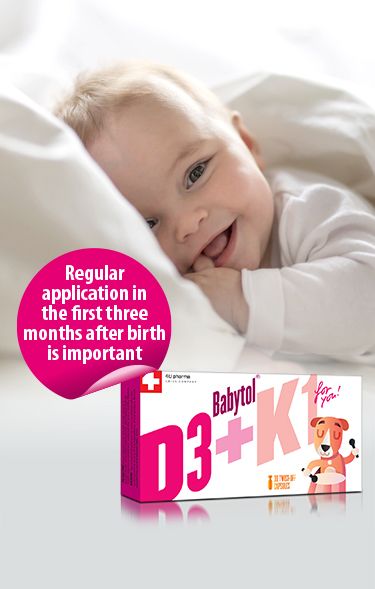

Babytol D3 + K1 capsules represent an additional source of vitamin D3 (cholecalciferol) and vitamin K1 (phylloquinone), intended for the nutritional needs of preterm infants and newborns during the period of early postnatal development, when nutritional reserves are limited and the body’s demands are increased.
Vitamin D3 is a fat-soluble vitamin that plays a key role in the regulation of calcium and phosphorus metabolism. Its primary biological function is to contribute to the normal absorption and utilization of calcium and phosphorus, the maintenance of normal blood calcium levels, as well as the normal growth and development of bones in children. These health claims are approved in accordance with Commission Regulation (EU) No 432/2012 and are based on the scientific evaluation of the European Food Safety Authority (EFSA). During the neonatal period, vitamin D requirements are increased due to intensive skeletal mineralization and rapid growth, while skin synthesis is limited due to reduced exposure to UVB radiation. The American Academy of Pediatrics (AAP) and the Centers for Disease Control and Prevention (CDC) recommend a daily intake of 400 IU (10 µg) of vitamin D for newborns and infants, including those who are breastfed.
Vitamin K1 (phylloquinone) is the primary nutritional form of vitamin K and plays a key role in the synthesis of proteins involved in the coagulation process. According to regulatory approved health claims of the European Union, vitamin K contributes to normal blood clotting and the maintenance of normal bones, which is also confirmed by Commission Regulation (EU) No 432/2012 based on EFSA evaluation. Newborns are born with limited vitamin K stores due to reduced placental transfer during pregnancy, which is documented in neonatology literature and forms the basis for routine postnatal prophylaxis in many healthcare systems. The concentration of vitamin K in breast milk is relatively low compared to infant formulas, which are fortified with vitamin K in accordance with Commission Delegated Regulation (EU) 2016/127 on infant formula and follow-on formula. In preterm infants, nutritional reserves may be further reduced due to the shorter duration of intrauterine development, which is why adequate nutritional support is particularly important.
The use of one capsule per day allows a precisely defined intake of vitamin D3 and K1, in accordance with the instructions for use and the advice of a healthcare professional.
Source
Commission Regulation (EU) No 432/2012. Establishing a list of permitted health claims made on foods, other than those referring to the reduction of disease risk and to children's development and health. Official Journal of the European Union. 2012. Regulation of the European Union establishing a list of permitted health claims for foods, including approved claims for vitamin D (calcium absorption, blood calcium levels, bone health) and vitamin K (blood clotting, maintenance of normal bones).
https://eur-lex.europa.eu/legal-content/EN/TXT/?uri=CELEX:32012R0432
Commission Delegated Regulation (EU) 2016/127 of 25 September 2015 supplementing Regulation (EU) No 609/2013 as regards the specific compositional and information requirements for infant formula and follow-on formula. Official Journal of the European Union. 2016. Delegated regulation defining composition, nutritional requirements, and permitted ranges of vitamins and minerals (including vitamin D) in infant formula and follow-on formula.
https://eur-lex.europa.eu/legal-content/EN/TXT/?uri=CELEX:32016R0127
Holick MF. Vitamin D deficiency. New England Journal of Medicine. 2007 Jul 19;357(3):266–281. A review paper that examines in detail the epidemiology, causes, clinical manifestations, and consequences of vitamin D deficiency, including rickets in children and osteomalacia in adults.
doi: 10.1056/NEJMra070553
https://www.nejm.org/doi/full/10.1056/NEJMra070553
Wagner CL, Greer FR. Prevention of rickets and vitamin D deficiency in infants, children, and adolescents. Pediatrics. 2008 Nov;122(5):1142–1152. Guidelines from the American Academy of Pediatrics defining recommendations for vitamin D supplementation in infants, children, and adolescents to prevent rickets and maintain adequate vitamin D status.
doi: 10.1542/peds.2008-1862
https://publications.aap.org/pediatrics/article/122/5/1142/71470/Prevention-of-Rickets-and-Vitamin-D-Deficiency-in
Newborns are physiologically born with very low levels of vitamin K in the blood and limited stores of this vitamin in the liver. The reason for this is the minimal transfer of vitamin K through the placenta during pregnancy, resulting in low initial reserves at birth. This characteristic of the neonatal period is described in detail in the review by Shearer (Blood Reviews, 2009), which states that vitamin K stores at birth are low due to poor placental transfer and limited hepatic reserves.
The Centers for Disease Control and Prevention (CDC) also states that babies are born with very small amounts of vitamin K and that, without adequate intake, they may be at increased risk of conditions associated with vitamin K deficiency in early life.
After birth, a portion of vitamin K can be produced in the intestines through the activity of bacteria that synthesize menaquinones (vitamin K2). However, intestinal colonization and the development of a stable microbiota occur gradually during the first weeks of life. Therefore, the contribution of endogenous vitamin K synthesis in the early neonatal period is limited, which is noted in expert reviews as an additional factor affecting the low initial vitamin K status (Shearer, Blood Reviews, 2009).
Low initial reserves, poor placental transfer, and delayed intestinal colonization together explain why the neonatal period is considered a phase of increased sensitivity with regard to vitamin K intake.
Sources
Shearer MJ. Vitamin K deficiency bleeding (VKDB) in early infancy. Blood Reviews. 2009;23(2):49–59. A review explaining the physiologically low vitamin K status at birth, poor placental transfer, and limited hepatic reserves in newborns.
https://pubmed.ncbi.nlm.nih.gov/18804903/
Centers for Disease Control and Prevention (CDC). Vitamin K Deficiency Bleeding (VKDB) – Fact Sheet. An expert overview stating that babies are born with very small amounts of vitamin K due to limited transfer during pregnancy and low reserves.
https://www.cdc.gov/vitamin-k-deficiency/index.html
Breast milk contains relatively low concentrations of vitamin K1 (phylloquinone). Expert reviews state that vitamin K concentrations in human milk are significantly lower compared to infant formulas, which are fortified with vitamin K in accordance with regulatory requirements (Shearer, Blood Reviews, 2009). Due to these low concentrations, exclusively breastfed infants without additional intake may have limited nutritional intake of this vitamin in early life.
European regulation on infant formula and follow-on formula prescribes mandatory fortification with vitamin K in clearly defined amounts, ensuring controlled and standardized intake in formula-fed infants (Commission Delegated Regulation (EU) 2016/127).
In order to ensure adequate vitamin K status immediately after birth, a single dose of 1 mg of vitamin K1 is routinely administered in maternity wards in most European countries. This practice represents a standard preventive measure based on clinical evidence and long-standing public health use, as documented in review papers on vitamin K deficiency bleeding in newborns (Shearer, Blood Reviews, 2009).
In some countries, prolonged oral administration of vitamin K is also recommended during the first weeks or months of life, particularly in exclusively breastfed infants. National guidelines and protocols define the duration and regimen of administration in accordance with the public health practices of each country.
Sources
Shearer MJ. Vitamin K deficiency bleeding (VKDB) in early infancy. Blood Reviews. 2009;23(2):49–59. A review analyzing low vitamin K content in breast milk, limited reserves at birth, and the public health basis for neonatal vitamin K prophylaxis.
https://pubmed.ncbi.nlm.nih.gov/18804903/
Commission Delegated Regulation (EU) 2016/127 of 25 September 2015 supplementing Regulation (EU) No 609/2013 as regards the specific compositional and information requirements for infant formula and follow-on formula. Regulation defining mandatory amounts of vitamin K in infant formulas in the European Union.
https://eur-lex.europa.eu/legal-content/EN/TXT/?uri=CELEX:32016R0127
Vitamin K plays a key role in the synthesis of vitamin K-dependent coagulation factors in the liver. When vitamin K intake is insufficient, the activity of these factors may be reduced, increasing the risk of coagulation disorders in early life. Expert reviews state that vitamin K deficiency is the primary etiological factor in the development of vitamin K deficiency bleeding in newborns (VKDB), including the late form that occurs after the second week of life (Shearer, Blood Reviews, 2009).
Late hemorrhagic disease of the newborn (late VKDB) most commonly occurs between the second week and the third month of life, and one of the main risk factors is exclusive breastfeeding without additional vitamin K supplementation (Shearer, Blood Reviews, 2009). The Centers for Disease Control and Prevention (CDC) also state that infants who do not receive adequate vitamin K prophylaxis are at increased risk of developing the late form of VKDB.
In accordance with certain national protocols and pediatric guidelines, prolonged oral administration of vitamin K is recommended after the initial dose at birth. A daily additional intake of 25 µg of vitamin K1 is recommended from the eighth day of life until the end of the third month, especially in exclusively breastfed infants, in order to ensure stable nutritional status during a period of increased vulnerability.
Sources
Shearer MJ. Vitamin K deficiency bleeding (VKDB) in early infancy. Blood Reviews. 2009;23(2):49–59. A review analyzing the pathophysiology of vitamin K deficiency, clinical forms of VKDB, and risk factors, including the late form of the disease in exclusively breastfed infants.
https://pubmed.ncbi.nlm.nih.gov/18804903/
Centers for Disease Control and Prevention (CDC). Vitamin K Deficiency Bleeding (VKDB). An expert overview describing early, classical, and late forms of VKDB and outlining risk factors associated with vitamin K deficiency.
https://www.cdc.gov/vitamin-k-deficiency/index.html
The Serbian Pediatric Association recommends 25 mcg of vitamin K and 400 IU of vitamin D from the eighth day until the end of the third month for exclusively breastfed infants.
https://www.udruzenjepedijatara.rs/wp-content/uploads/2023/07/vitamin_kk.pdf
Vitamin D plays a key role in the regulation of calcium and phosphorus metabolism and is essential for proper mineralization of bone tissue during periods of intensive growth. In early life, when the skeleton is developing rapidly, adequate vitamin D status represents an important nutritional factor for normal bone development.
Vitamin D deficiency is recognized as a risk factor for the development of rickets, a condition characterized by impaired mineralization of growing bone. Expert reviews state that vitamin D deficiency leads to reduced intestinal absorption of calcium, which may result in bone softening and deformities in infants and young children (Holick, New England Journal of Medicine, 2007).
The American Academy of Pediatrics (AAP) emphasizes that ensuring adequate daily intake of vitamin D is essential for the prevention of rickets and the maintenance of normal skeletal development during childhood (Pediatrics). Due to limited exposure to sunlight and variable endogenous synthesis, vitamin D supplementation represents a standard approach to ensuring consistent daily intake in infants.
Sources
Holick MF. Vitamin D deficiency. New England Journal of Medicine. 2007;357(3):266–281. A review analyzing the causes and consequences of vitamin D deficiency, including the pathophysiology of rickets and its impact on calcium metabolism and bone mineralization.
https://www.nejm.org/doi/full/10.1056/NEJMra070553
Wagner CL, Greer FR; American Academy of Pediatrics. Prevention of rickets and vitamin D deficiency in infants, children, and adolescents. Pediatrics. 2008;122(5):1142–1152. Guidelines defining recommendations for vitamin D intake for the prevention of rickets in childhood.
https://pubmed.ncbi.nlm.nih.gov/18977996/
Extended vitamin D supplementation in early childhood represents a standard public health recommendation in many countries. The American Academy of Pediatrics (AAP) recommends a daily intake of 400 IU (10 µg) of vitamin D for all infants, including those who are breastfed, starting from the first days of life, in order to ensure adequate vitamin D status and prevent rickets (Wagner & Greer, Pediatrics, 2008). The Centers for Disease Control and Prevention (CDC) also state the same recommended daily dose for children under 12 months of age.
Regarding vitamin K, routine administration after birth represents a standard preventive measure in most European countries. In certain national protocols, prolonged oral administration of vitamin K is also recommended during the first weeks or months of life, especially in exclusively breastfed infants, in order to maintain a stable nutritional status during a period of increased vulnerability (Shearer, Blood Reviews, 2009).
Babytol D3 + K1 capsules contain 25 µg of vitamin K1 and 400 IU of vitamin D3, enabling intake levels aligned with current pediatric recommendations for early childhood. The combination of vitamins D3 and K1 provides nutritional support during a period of intensive growth and development, in accordance with current professional guidelines.
Sources
Wagner CL, Greer FR; American Academy of Pediatrics. Prevention of rickets and vitamin D deficiency in infants, children, and adolescents. Pediatrics. 2008;122(5):1142–1152. Guidelines defining the recommended daily intake of 400 IU of vitamin D in infants for the prevention of rickets.
https://pubmed.ncbi.nlm.nih.gov/18977996/
Centers for Disease Control and Prevention (CDC). Vitamin D | Infant and Toddler Nutrition. Recommendations on daily vitamin D intake in children under 12 months.
https://www.cdc.gov/infant-toddler-nutrition/vitamins-minerals/vitamin-d.html
Shearer MJ. Vitamin K deficiency bleeding (VKDB) in early infancy. Blood Reviews. 2009;23(2):49–59. A review analyzing public health recommendations and extended vitamin K prophylaxis in early childhood.
https://pubmed.ncbi.nlm.nih.gov/18804903/

Vitamin K1 – a key vitamin in the coagulation process
Vitamin K1 (phylloquinone) is often referred to as the “coagulation vitamin” due to its key role in the synthesis of proteins involved in normal blood clotting. These proteins are activated in the liver in the presence of vitamin K, as described in detail in expert reviews on vitamin K metabolism (Shearer, Blood Reviews, 2009).
In early life, especially during the first three months, adequate vitamin K status is of particular importance. Vitamin K deficiency is recognized as the primary risk factor for the development of vitamin K deficiency bleeding in newborns (VKDB), including the late form that may occur between the second week and the third month of life (Shearer, Blood Reviews, 2009). For this reason, the neonatal period is considered a phase of increased sensitivity with regard to vitamin K intake.
According to regulatory approved health claims of the European Union, vitamin K contributes to normal blood clotting and the maintenance of normal bones (Commission Regulation (EU) No 432/2012).
Sources
Shearer MJ. Vitamin K deficiency bleeding (VKDB) in early infancy. Blood Reviews. 2009;23(2):49–59. A review explaining the role of vitamin K in coagulation, the pathophysiology of deficiency, and risk factors for the late form of VKDB.
https://pubmed.ncbi.nlm.nih.gov/18804903/
Commission Regulation (EU) No 432/2012. Establishing a list of permitted health claims made on foods. Regulation approving the health claim that vitamin K contributes to normal blood clotting.
https://eur-lex.europa.eu/legal-content/EN/TXT/?uri=CELEX:32012R0432

Vitamin D3 – role in calcium absorption and bone development
Vitamin D3 (cholecalciferol) is the biologically active form of vitamin D that is naturally synthesized in the skin under the influence of UVB radiation, which is why it is often referred to as the “sun vitamin.” In the body, it plays an important role in regulating calcium and phosphorus metabolism, minerals that are essential for proper mineralization of bone tissue.
According to regulatory approved health claims of the European Union, vitamin D contributes to the normal absorption and utilization of calcium and phosphorus, the maintenance of normal blood calcium levels, as well as the normal growth and development of bones in children (Commission Regulation (EU) No 432/2012).
In early life, when intensive skeletal growth and development occur, adequate vitamin D status represents an important nutritional factor. Vitamin D deficiency is recognized as a risk factor for the development of rickets, a condition characterized by impaired mineralization of growing bone (Holick, New England Journal of Medicine, 2007). Due to limited exposure to sunlight, especially during autumn and winter months, vitamin D3 supplementation represents a standard approach to ensuring consistent daily intake in infants.
Sources
Commission Regulation (EU) No 432/2012. Establishing a list of permitted health claims made on foods. Official Journal of the European Union. 2012. Regulation approving health claims that vitamin D contributes to the normal absorption and utilization of calcium and phosphorus, maintenance of normal blood calcium levels, and normal growth and development of bones in children.
https://eur-lex.europa.eu/legal-content/EN/TXT/?uri=CELEX:32012R0432
Holick MF. Vitamin D deficiency. New England Journal of Medicine. 2007;357(3):266–281. A review analyzing the pathophysiology of vitamin D deficiency and its association with rickets and impaired bone mineralization.
https://www.nejm.org/doi/full/10.1056/NEJMra070553

Olive oil – lipid base for vitamins D3 and K1
Vitamins D3 and K1 are fat-soluble vitamins, meaning they dissolve in fats and their absorption in the digestive tract occurs in the presence of lipids. Expert reviews state that the presence of fat is necessary for adequate intestinal absorption of vitamin D, as it is transported together with lipids within micelles and chylomicrons (Holick, New England Journal of Medicine, 2007).
For this reason, vitamins D3 and K1 in this product are dissolved in olive oil, which provides a stable lipid environment suitable for their physiological absorption.
Source
Holick MF. Vitamin D deficiency. New England Journal of Medicine. 2007;357(3):266–281. A review explaining the metabolism, transport, and absorption of vitamin D, including its fat-soluble nature and dependence on the presence of fat in the digestive tract.
https://www.nejm.org/doi/full/10.1056/NEJMra070553
Additional information
Please note that the referenced clinical studies and scientific sources relate to individual product ingredients and their effects, not to the product as a whole.

The simplest method of administration – twist-off capsule
Babytol D3 + K1 contains individually dosed twist-off capsules intended for simple and precise administration in infants and young children.
The capsule is opened by gently twisting and separating the tip, after which the content can be squeezed directly into the baby’s mouth or onto a spoon. This method of administration enables clearly defined dosing without the need for additional measurement.
Each capsule contains a precisely defined amount of vitamin D3 and vitamin K1, ensuring consistent daily intake in accordance with the recommended use.

Use in breastfed infants
In exclusively breastfed infants, after discharge from the maternity ward, some national protocols recommend the continuation of oral vitamin K1 administration. The reason for this recommendation is that breast milk contains relatively low concentrations of vitamin K, while initial stores in the newborn are limited (Shearer, Blood Reviews, 2009).
Expert reviews on vitamin K deficiency bleeding in newborns (VKDB) state that the late form of this condition most commonly occurs in infants who are exclusively breastfed and do not receive additional vitamin K intake after the initial prophylaxis at birth (Shearer, Blood Reviews, 2009). For this reason, some countries have introduced protocols for extended oral administration of vitamin K during the first weeks or months of life.
A recommended additional intake of 25 µg of vitamin K1 per day, from the eighth day of life until the end of the third month, is stated in national guidelines of certain European countries as part of extended prophylaxis in breastfed infants, in order to maintain a stable nutritional status during a period of increased vulnerability.
Use should be in accordance with pediatric advice and current national recommendations.
Sources
Shearer MJ. Vitamin K deficiency bleeding (VKDB) in early infancy. Blood Reviews. 2009;23(2):49–59. A review analyzing risk factors for the late form of VKDB, including exclusive breastfeeding and protocols for extended oral vitamin K administration.
https://pubmed.ncbi.nlm.nih.gov/18804903/

Use in formula-fed infants
In infants who, before the third month of life, transition to mixed feeding with more than two formula feeds per day, vitamin K intake from formula may be adequate in accordance with current European regulations on the composition of infant formula (Commission Delegated Regulation (EU) 2016/127).
Given that infant formulas are fortified with vitamin K in regulatorily defined amounts, in such situations it may be appropriate to consider switching to a product containing vitamin D3 without added vitamin K1, in accordance with pediatric advice and the individual needs of the child.
If it is assessed that vitamin K intake through nutrition is sufficient, it is possible to switch to Babytol D3 + DHA Omega even before the fourth month of age.
Source
Commission Delegated Regulation (EU) 2016/127 of 25 September 2015 supplementing Regulation (EU) No 609/2013 as regards the specific compositional and information requirements for infant formula and follow-on formula. Regulation defining mandatory amounts of vitamin K in infant formulas in the European Union.
https://eur-lex.europa.eu/legal-content/EN/TXT/?uri=CELEX:32016R0127

We are grateful for the Babytola D3+K1 recommendation given to us at the maternity hospital. Our boy is now a healthy and smart two-year-old. On the pediatrician's advice, we give him Babytol DHA in the summer and Babytol D3 + DHA in the winter. All recommendations from our little family!

Vitamin D has a regulatory role in the functioning of the immune system. Expert reviews state that vitamin D influences both the innate and adaptive immune response, including the regulation of T and B lymphocyte activity, as well as the modulation of cytokine production. Vitamin D receptors are present on numerous immune cells, confirming its biological role in immunomodulation. Maintaining an adequate vitamin D status is associated with proper immune system function, while severe deficiency has been linked to increased susceptibility to certain immune-related disorders.
Source
Martens PJ, Gysemans C, Verstuyf A, Mathieu AC. Vitamin D’s Effect on Immune Function. Nutrients. 2020;12(5):1248. A review analyzing the immunomodulatory effects of vitamin D on innate and adaptive immune responses.
https://pmc.ncbi.nlm.nih.gov/articles/PMC7281985/
According to recommendations from the Centers for Disease Control and Prevention (CDC), children under 12 months of age require a daily intake of 400 IU (10 µg) of vitamin D, while for children aged 12 to 24 months the recommended daily intake is 600 IU (15 µg). The American Academy of Pediatrics (AAP) recommends a minimum daily intake of 400 IU of vitamin D starting soon after birth, in order to ensure an adequate nutritional status during early growth and development.
Sources
Centers for Disease Control and Prevention (CDC). Vitamin D | Infant and Toddler Nutrition. Official guidelines on recommended daily vitamin D intake in infants and young children.
https://www.cdc.gov/infant-toddler-nutrition/vitamins-minerals/vitamin-d.html
Wagner CL, Greer FR. Prevention of rickets and vitamin D deficiency in infants, children, and adolescents. Pediatrics. 2008;122(5):1142–1152. Guidelines from the American Academy of Pediatrics on vitamin D supplementation in childhood.
https://publications.aap.org/pediatrics/article/122/5/1142/71470/Prevention-of-Rickets-and-Vitamin-D-Deficiency-in
Newborns are born with limited vitamin K stores, and without adequate prophylaxis there is a risk of developing vitamin K deficiency bleeding in newborns (Vitamin K Deficiency Bleeding – VKDB). A review paper states that both oral and intramuscular administration of vitamin K after birth are effective in preventing early, classical, and late forms of VKDB. For this reason, vitamin K prophylaxis is considered a standard preventive measure in modern neonatology practice.
Source
Jullien S. Vitamin K prophylaxis in newborns. BMC Pediatrics. 2021;21(Suppl 1):350. A study examining the effectiveness and safety of vitamin K prophylaxis in newborns and the prevention of VKDB.
https://bmcpediatr.biomedcentral.com/articles/10.1186/s12887-021-02701-4
Please note that the referenced clinical studies and scientific sources relate to individual product ingredients and their effects, not to the product as a whole.

Vitamin K1 is also called the “coagulation vitamin” – it plays a very important role in complex blood clotting processes.
K1 deficiency is a risk factor for the development of late hemorrhagic disease.
If you give your baby more than two servings of milk formula per day, then it does not need vitamin K1, because it takes it in a sufficient dose through formula.
If the baby takes more than two servings of milk formula per day, continue vitamin D3 at a dose of 400 IU.
Human milk contains low concentrations of vitamin K1, so at average breastfeeding of 500 ml/24h, daily vitamin K1 requirements are not provided, which are increased in the first 6 months of life in the range of 1 – 25 µg.
Due to the low concentration of vitamin K1 in breast milk and the risk of vitamin K1 deficiency, all babies on a natural diet, in accordance with European and national recommendations, are recommended prolonged oral administration of vitamin K1 at a dose of 25 µg from day 8 to the end of the third month after birth.
Milk formulas are already enriched with vitamin K1, and depending on the daily intake of milk, the baby ingests about 50 µg of vitamin K1 per day through formulas.
If the baby takes more than two servings of formula per day, oral supplementation of Babytol D3 + K1 is not necessary.
If you have continued the use of Babytol D3 + K1 and your baby is taking the formula, do not worry, nothing bad will happen, because overdose at these doses is not possible.
Do not exceed the recommended daily dose.
Vitamin K1 at the recommended dose does not have any side effects, it can only help and protect your baby, so you can use it without any issues.
Late hemorrhagic disease is a severe and serious disease, which occurs due to a lack of vitamin K1. It most often occurs in the period from 2 to 12 weeks of life, with severe bleeding, most often cerebral.
Due to the serious and severe consequences of this disease, prophylaxis is mandatory in all newborns in the maternity hospital immediately after birth, at a dose of 1 mg administered by intramuscular injection.
In addition, in all newborns on a natural diet, in accordance with European and national recommendations, prolonged oral administration of vitamin K1 from day 8 to the end of the third month after birth is recommended.
Babytol D3+K1 is a combination of two important vitamins essential for your newborn in a daily dose.
The product is used from the 8th day of birth until the end of the 3rd month in newborns who are on breast milk and newborns who are on a mixed diet, with less than two servings of adapted formula during the day.
Vitamin A is not recommended in daily supplementation in newborns because breast milk is rich in this vitamin and there is no need for additional supplementation. It is also contained in the formulas in the recommended amount. Like vitamin D3, Vitamin A is liposoluble and higher than necessary amounts are deposited in the body of newborns and can lead to side effects.
The vitamins are dissolved in olive oil, which is completely safe for use in newborns and does not contain allergens.
The occurrence of cramps in newborns cannot be caused by vitamin D3 or vitamin K1

Copyright 2026 4uPharma. All Rights Reserved
Dajbog CMS, izrada sajta i SEO by Web Business Solutions

