

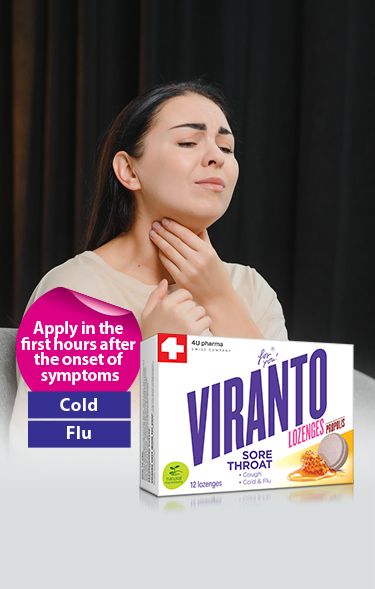

Viranto Lozenges for you! are pleasant-tasting lozenges with lemon, lime and refreshing mint flavor. They are intended for use during colds and flu, and are best taken at the very first signs of symptoms such as sore throat, cough, and inflammation of the respiratory mucosa.
They contain plant-based ingredients, vitamins, and minerals, including extracts of pelargonium root, elderberry fruit, acerola and rosehip, white willow bark, propolis, and marshmallow root, as well as zinc, copper, and vitamin D. The lozenges provide natural vitamin C sourced from acerola and rosehip fruits.
The product is intended for adults aged 18 years and older.
Viranto Lozenges for you! are an ideal choice when a sore throat is a prominent symptom of a cold or flu. Thanks to their specially designed formulation, the lozenges dissolve slowly, staying longer on the throat mucosa, where they gently coat the surface and provide enhanced local relief.
Viranto Lozenges for you! act both locally and systemically.
By slowly dissolving in the mouth, they coat the throat and oral mucosa, providing targeted local relief. After swallowing, the active ingredients are absorbed through the digestive tract and exert a systemic effect throughout the body.
African geranium (Pelargonium sidoides) is one of the most extensively studied medicinal plants for respiratory tract health. It has a long history of medical use in South Africa, where it is highly valued for its therapeutic properties.
Elderberry supports the normal function of the immune system and is rich in a wide range of beneficial compounds, including minerals, flavonoids, polyphenols, and vitamins. It is particularly high in vitamin C, beta-carotene, anthocyanins, tannins, and amino acids.
The use of white willow bark extract is rooted in centuries of traditional medicine across various cultures. References to willow bark as a remedy for different conditions can be found in texts dating back to antiquity, including the writings of Hippocrates and Galen. One of the key active compounds in willow bark is salicin, which is metabolized in the body into salicylic acid.
Marshmallow (Althaea officinalis) has been used for over 2,000 years. Its name is derived from the Latin word “altho,” meaning “to heal” or “to soothe.” The plant is well known for the high content of mucilaginous substances in its root, which are responsible for its soothing properties and traditional use.
In traditional medicine, propolis is often referred to as a “gift from bees” due to its broad range of applications. Bees use propolis to protect and disinfect their hives, which inspired its traditional use in supporting oral and throat hygiene in humans.
Acerola fruit extract is exceptionally rich in vitamin C and also contains high levels of flavonoids, anthocyanins, and organic acids, contributing to excellent vitamin C bioavailability. In addition, acerola provides vitamin A and B-complex vitamins.
Rosehip has been traditionally used in many cultures around the world. Its richness in beneficial compounds has been known for centuries. In addition to vitamin C, rosehip contains B-group vitamins, provitamin A, vitamin K, pectin, flavonoids, tannins, carotene, proanthocyanidins, and others.
Early use is advised, at the first signs of cold or flu, such as sore throat, cough, and inflammation of the nasal and throat mucosa.
We recommend that Viranto Lozenges for You! always be part of your home and travel first-aid kit, so they can be used within the first hours after the onset of cold and flu symptoms. Use the product as recommended by a physician.

Pelargonium
Pelargonium originates from South Africa and, in the local language, means “good for the lungs.”

White willow
Willow is rich in various active compounds such as salicylic acid derivatives, tannins, and flavonoids.

Elderberry
Elderberry is a well-known medicinal plant since ancient times.
Elderberry fruit juice is extremely rich in flavonoids, as well as vitamins C and A, B-group vitamins, and selenium.

Zinc
A mineral of great importance for the proper functioning of the immune system.

Acerola
Acerola contains up to 100 times more vitamin C compared to lemon and orange. Vitamin C contributes to immune system function and helps reduce fatigue and exhaustion.

Rosehip
A source of natural vitamin C in high concentration. Traditionally used for colds and flu. Rich in powerful antioxidants such as anthocyanins and flavonoids.

Propolis
Propolis has a complex composition and consists of more than 300 bioactive compounds. It contains powerful antioxidants—flavonoids, phenolic acids, essential oils, and resins.

Marshmallow
The most important substances in marshmallow are plant mucilages (mucopolysaccharides), which form a protective mucous layer upon contact with fluids.

Apply at the first symptoms
Apply within the first hours of the onset of cold and flu symptoms - sore throat, cough, and other discomforts.

Dosage
Adults: Dissolve one lozenge slowly in the mouth four times daily.

After a meal
Best used with or after a meal.

A meta-analysis of randomized, controlled clinical trials showed that black elderberry supplementation significantly reduces both the duration and severity of upper respiratory tract symptoms, offering a natural and effective option for managing cold and flu symptoms.
Medicinal plants rich in polyphenols and characterized by antiviral activity (such as Pelargonium sidoides, Sambucus nigra, etc.) appear to be suitable candidates for further research aimed at identifying effective therapeutic options against SARS-CoV-2 infection, due to their combined antimicrobial and anti-inflammatory properties.
This study investigates the potential of Sambucus nigra and describes its inhibitory activity in preventing the binding between the SARS-CoV-2 spike protein receptor-binding domain (RBD) and the human ACE2 receptor, revealing a novel biological activity of S. nigra.
An aqueous extract of Rosa canina demonstrated high phenolic content, indicating a strong antioxidant potential.
Systematic reviews highlight the effectiveness of white willow bark in reducing inflammation, relieving pain, and lowering fever, supporting its use as a scientifically validated herbal remedy.
With salicin as its active constituent, Salix alba offers a gentler, natural option for anti-inflammatory and analgesic support, reducing reliance on synthetic medications.
A 2023 systematic review and meta-analysis demonstrated that white willow bark extract significantly reduces pain and improves physical function in patients with arthritis, without an increased risk of adverse effects compared to placebo.
White willow bark (Salicis cortex) is standardized as a natural source of salicin, an active compound known for its anti-inflammatory, analgesic, and antipyretic properties.
As a pharmaceutically controlled substance included in the European Pharmacopoeia, it meets strict quality requirements and represents a natural alternative to synthetic drugs, with a reduced risk of adverse effects.
Research has shown that willow bark extracts possess antiviral properties, which may help strengthen the body’s natural defense against viral infections.
The results of this retrospective analysis clearly show that the use of propolis-based products reduces symptom severity in cases of acute otitis media and decreases both the duration (in some cases) and severity of symptoms in non-streptococcal pharyngitis, as well as the rate of progression to tracheitis, bronchitis, and/or rhinosinusitis.
Its use in acute otitis media and pharyngitis significantly reduced the need for antipyretic and anti-inflammatory medications in children.
The study was conducted in patients with acute otitis media and/or non-streptococcal pharyngitis.
Type of propolis preparation: a propolis–phytosome mixture containing 75 mg of pure propolis per sachet.
Study population: children older than 2 years, n = 28.
The preparation was effective in patients with non-streptococcal and viral pharyngitis caused by paramyxoviruses, rhinoviruses, and adenoviruses.
Propolis reduced symptoms such as sore throat, fever, and pharyngeal erythema.
The results of animal and clinical studies confirmed the efficacy of Althaea officinalis extract alone in the treatment of dry cough.
Our findings suggest that various extracts of Althaea officinalis can be considered sources of phenolic and flavonoid compounds with high potential as natural antioxidants, anti-inflammatory agents, and regulators of blood glucose levels. In addition, they may be used in food products and dietary supplements.
The results showed that users reported significant relief of cough symptoms and rated the extract as well tolerated. These findings support the traditional use of Althaea officinalis in the treatment of cough associated with respiratory tract infections.
Althaea officinalis root exhibits demulcent, expectorant, anti-inflammatory, and soothing effects. It is used in the treatment of irritative cough, hoarseness, and pharyngitis.


Copyright 2026 4uPharma. All Rights Reserved
Dajbog CMS, izrada sajta i SEO by Web Business Solutions

